Roth IRA vs Traditional IRA: Which Is Better for Beginners?
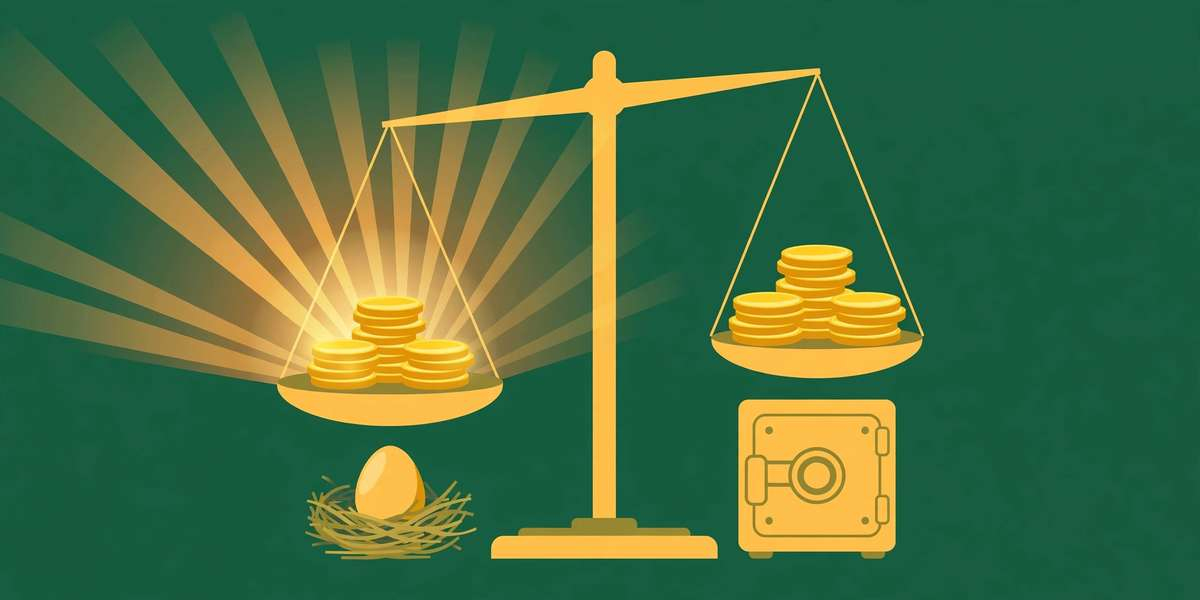
Open a Roth or a Traditional? It’s the question that freezes more beginners than any other in personal finance — and the irony is that either choice beats the most common alternative, which is doing nothing and letting another year of tax-advantaged compounding slip away.
Both are Individual Retirement Arrangements: special accounts where your investments grow with major tax advantages. The entire debate comes down to one question: do you want the tax break now, or later? Let’s make the answer obvious.
The core difference in one paragraph
- Traditional IRA: You get a tax deduction now on contributions (if you qualify), the money grows tax-deferred, and you pay income tax on withdrawals in retirement. Tax break today, taxes later.
- Roth IRA: You contribute after-tax dollars (no deduction now), the money grows tax-free, and qualified withdrawals in retirement are completely tax-free. Taxes today, never again.
Same investments allowed inside both. Same annual contribution limit. The only thing that changes is when the IRS gets its cut — and that timing is everything.
Side-by-side comparison
| Feature | Roth IRA | Traditional IRA |
|---|---|---|
| Tax break | None now; tax-free later | Deduction now (if eligible); taxed later |
| 2026 contribution limit | $7,000 ($8,000 if 50+) | $7,000 ($8,000 if 50+) — shared across both |
| Income limits | Yes — phases out at higher incomes | Deduction phases out if covered by workplace plan |
| Withdrawal age | Contributions anytime; earnings at 59½ | Generally 59½ (10% penalty + tax before) |
| Required withdrawals | None in your lifetime | Required minimum distributions at 73 |
| Best for | Lower earners, young savers | High earners wanting today’s deduction |
Why most beginners should choose the Roth IRA
If you’re early in your career, the math strongly favors Roth. Here’s why:
1. Your tax rate is probably the lowest it’ll ever be. Beginners are typically in the 10–22% federal brackets. Paying 12% tax on a contribution today to avoid paying (say) 22–24% on a much larger balance in retirement is a fantastic trade. High earners in the 32%+ brackets get more value from the Traditional’s upfront deduction.
2. Flexibility when life happens. Roth IRA contributions (not earnings) can be withdrawn anytime, with no tax and no penalty. That makes a Roth function as a backup emergency fund in a true crisis — a Traditional IRA locks everything behind the age-59½ wall (with limited exceptions). Beginners with thin cash cushions benefit enormously from this escape hatch.
3. No forced withdrawals. Traditional IRAs force you to start taking required minimum distributions at 73, whether you need the money or not — and pay tax on them. Roth IRAs have no lifetime RMDs for the original owner, giving you total control.
4. Tax diversification for the future. Nobody knows future tax rates. Having a pool of money the IRS can never touch is valuable insurance against higher taxes decades from now.
When the Traditional IRA wins
The Traditional IRA isn’t the consolation prize — it’s the right answer in specific situations:
- You’re in a high tax bracket now and expect a lower one in retirement. Classic example: a peak-earning professional in the 32–37% bracket. The upfront deduction is worth more than the back-end tax freedom.
- You’re covered by a workplace retirement plan and earn too much for Roth. The deduction phases out, but the tax-deferred growth still beats a taxable account.
- You need every dollar of cash flow today. The deduction effectively makes your contribution cheaper — a $7,000 contribution at a 24% bracket costs you only $5,320 out of pocket after the tax savings.
- You plan to do Roth conversions in low-income years. Some savers deduct now and convert to Roth during sabbaticals, grad school, or early retirement when their bracket drops.
The 60-second decision framework
Answer these in order; stop at the first “yes”:
- Does your employer offer a 401(k) match? → Contribute there first, up to the full match. Free money beats IRA tax optimization every time.
- Are you in the 10%, 12%, or 22% federal bracket? → Roth IRA. Your rate is low; lock in tax-free growth.
- Are you in the 32% bracket or higher? → Traditional IRA (deductible) for the immediate tax relief.
- In the 24% bracket or unsure? → Roth IRA as the default. The flexibility alone tips it for beginners.
If you’re a student, early-career worker, freelancer with variable income, or anyone whose best earning years are ahead — Roth, no contest.
See What an IRA Contribution Does to Your Budget
A $583/month max IRA contribution sounds big until you see the numbers. Run your income through the free budget calculator and find your real savings capacity.
Open the Free Budget CalculatorHow to open one (and what to buy inside)
Opening either IRA takes about 15 minutes at any major low-cost brokerage:
- Choose a provider known for low fees and good fund selection.
- Select “Roth IRA” or “Traditional IRA” as the account type.
- Link your bank and fund it — start with whatever you have (see our guide to starting with just $100).
- Buy something. The most common beginner mistake is funding the IRA and leaving the cash uninvested. A total stock market index fund or a target-date fund matching your retirement year are both excellent defaults.
- Set up automatic monthly contributions so you hit the annual max without thinking about it.
Mistakes beginners make with IRAs
- Missing the deadline. You can contribute for a given tax year until mid-April of the following year — but don’t procrastinate; earlier contributions get more compounding time.
- Contributing to both and exceeding the limit. The $7,000 cap is combined across all your IRAs, not per account. Overcontributing triggers a 6% annual penalty on the excess until fixed.
- Forgetting the income limits. Roth eligibility phases out at higher incomes; Traditional deductibility phases out if you have a workplace plan. Check the current IRS thresholds each year.
- Raiding the Roth casually. Yes, you can withdraw contributions penalty-free — but every dollar pulled out stops compounding. Reserve that escape hatch for genuine emergencies, and keep a real emergency fund separate.
FAQ
Q: Which is better for beginners, Roth or Traditional IRA?
A: For most beginners, a Roth IRA wins. You’re likely in a lower tax bracket now than you’ll be in retirement, so paying taxes now and withdrawing tax-free later is usually the better deal — plus Roth IRAs offer more flexibility for early withdrawals.
Q: Can I have both a Roth and a Traditional IRA?
A: Yes, you can hold both, but your combined contributions can’t exceed the annual limit ($7,000 in 2026, or $8,000 if you’re 50+). Some people split contributions, though most beginners are better off picking one and keeping it simple.
Q: What happens if I earn too much for a Roth IRA?
A: Roth IRAs have income limits. If you earn above them, you can use the “backdoor Roth” strategy: contribute to a Traditional IRA (no income limit for contributions) and convert it to a Roth. It requires some paperwork but is fully legal.
Q: When can I withdraw money from an IRA without penalty?
A: Roth IRA contributions can be withdrawn anytime, tax- and penalty-free. Earnings are penalty-free after age 59½ (and the account is 5+ years old). Traditional IRA withdrawals before 59½ generally face a 10% penalty plus income tax, with a few exceptions.
Keep reading

11 Best Money Books for Beginners That Are Actually Worth Reading
Skip the hype. These 11 best money books for beginners actually teach you to budget, save, invest, and build wealth — plus which one to read first and how to finish them.
Read more →
How to Start Investing With Just $100 (2026 Beginner's Guide)
You can start investing with just $100 in 2026. This beginner's guide shows the exact account to open, what to buy, and how small amounts compound into real wealth.
Read more →
What Is Compound Interest? (With Examples That Finally Click)
Compound interest explained with examples that finally make sense. See how small, consistent investing grows into real wealth — plus the Rule of 72 and a $100/month example.
Read more →