How to Start Investing With Just $100 (2026 Beginner's Guide)
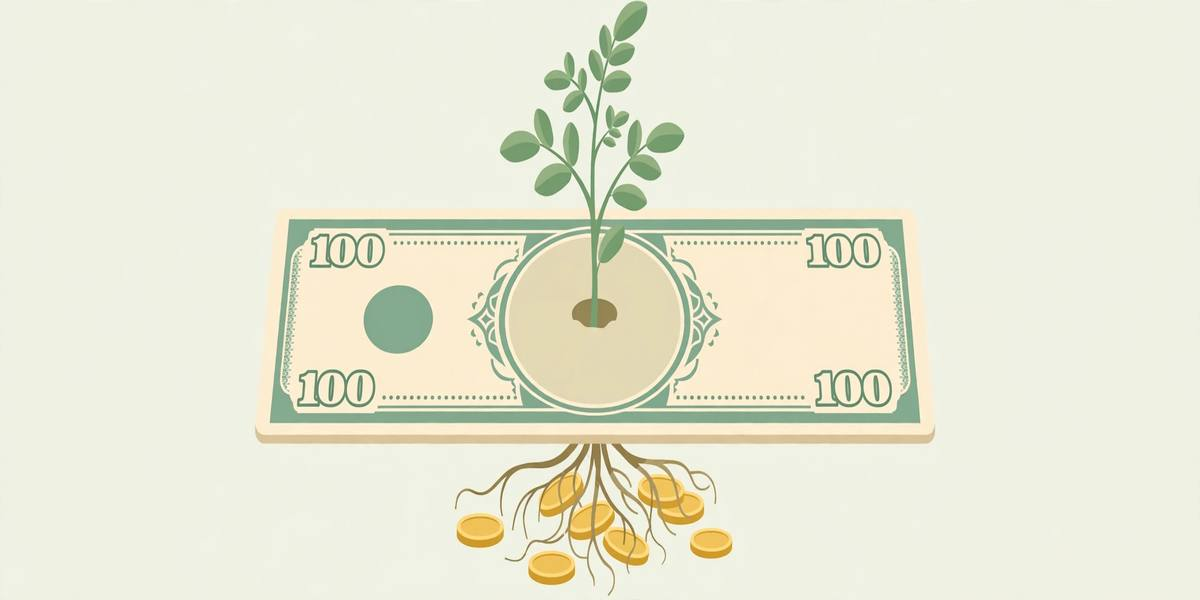
A hundred dollars feels too small to matter. It can’t buy a house, can’t fund retirement, can’t even fill a grocery cart for a month in some cities. So most people wait — they’ll start investing “when they have real money.”
Here’s the uncomfortable math: waiting is the expensive part. If you invest $100 a month starting at 25 and earn a 7% average annual return, you’ll have about $214,000 by age 65. Start at 35 instead and you’ll have about $101,000. That ten-year wait cost $113,000 — and the monthly investment never changed.
You don’t need a windfall to start. You need $100, an account, and a plan simple enough to stick with. Here’s exactly how.
Myth-busting: what $100 can and can’t do
Let’s clear out the beliefs that keep beginners on the sidelines:
- Myth: “You need thousands to start.” Reality: most major brokerages now have $0 minimum deposits, and fractional shares let you buy slices of ETFs for $1–$5. Your $100 is fully usable on day one.
- Myth: “You need to pick winning stocks.” Reality: stock-picking is a losing game for professionals, let alone beginners. You’ll own hundreds of companies at once through index funds.
- Myth: “You should wait for the right time.” Reality: time in the market beats timing the market. Investors who wait for a dip usually wait forever and miss the gains.
- Myth: “$100 won’t make a difference anyway.” Reality: the first $100 matters because it builds the habit and the account. The habit compounds faster than the money.
Step 1: Build a tiny launchpad first (2–4 weeks)
Investing $100 while carrying 24% APR credit card debt is like filling a bathtub with the drain open. Before you invest, do two quick things:
- Stash a mini emergency fund of $500–$1,000. This keeps you from selling investments at the worst possible moment when life happens. Park it in a high-yield savings account — see our roundup of the best high-yield savings accounts.
- List your debts by interest rate. Anything above ~10% APR (most credit cards) should be attacked before serious investing. Lower-rate debt, like federal student loans, can ride alongside your new investing habit.
This isn’t about being perfect — it’s about making sure your first investments survive contact with real life.
Step 2: Open the right account (15 minutes)
Where you invest matters as much as what you buy, because account types decide your taxes. For most beginners, the choice is simple:
- Roth IRA (best first account for most beginners): You contribute after-tax dollars, but the money grows tax-free and you withdraw it tax-free in retirement. For 2026, you can contribute up to $7,000/year ($8,000 if 50+). If your income is modest now, paying taxes today at a low rate and never again is a steal.
- Traditional 401(k) (if your employer offers a match): If your job matches contributions, contribute enough to grab the full match first — that’s an instant 50–100% return no investment can beat.
- Taxable brokerage account: No tax perks, but no contribution limits or withdrawal restrictions either. Good as a second account once the IRA is funded.
Your $100 starter move: Open a Roth IRA at a low-cost brokerage. It takes about 15 minutes online, requires no minimum at most providers, and your $100 starts compounding tax-free immediately.
Step 3: Buy one simple thing
Decision fatigue kills more beginner portfolios than bad markets. So keep it to one choice:
- Option A — Total U.S. stock market ETF (e.g., VTI): One purchase owns ~3,500 American companies. Expense ratio around 0.03%. This is the entire U.S. economy in a single ticker.
- Option B — Target-date fund (e.g., one matching your expected retirement year): A fund that automatically shifts from stocks to bonds as you age. Slightly higher fees (~0.08%), but truly set-and-forget.
- Option C — S&P 500 ETF (e.g., VOO): The 500 biggest U.S. companies. Nearly identical long-term results to Option A.
Any of the three is a fine answer. What ruins beginners isn’t picking the “wrong” index fund — it’s constantly switching, chasing hot stocks, or panic-selling. Pick one, buy with your $100, and move on with your life.
Step 4: Automate $100/month and ignore the news
One-time investing is a gesture; automatic investing is a wealth strategy. Here’s why automation wins:
- It removes willpower from the equation. The transfer happens on payday before you can spend it.
- It buys the dips automatically. When markets fall, your fixed $100 buys more shares — this is dollar-cost averaging, and it works without you thinking about it.
- It compounds the habit. After three months, investing is just something you do, like paying rent.
Set up an automatic transfer of $100 (or whatever you can) to your Roth IRA on the day after each payday. Then delete the brokerage app from your phone’s home screen. Checking daily adds stress and zero returns.
Find Your $100 in Your Budget
Use the free budget calculator to spot exactly where your first $100/month of investing money can come from — most people find it in subscriptions and dining out.
Open the Free Budget CalculatorWhat $100/month actually becomes
Assuming a 7% average annual return (below the stock market’s long-term ~10% average, to stay conservative):
| Monthly investment | 20 years | 30 years | 40 years |
|---|---|---|---|
| $100 | ~$52,000 | ~$122,000 | ~$264,000 |
| $200 | ~$104,000 | ~$245,000 | ~$528,000 |
| $300 | ~$157,000 | ~$367,000 | ~$792,000 |
Two things to notice: the growth accelerates wildly in later years (that’s compounding), and doubling the monthly amount roughly doubles the result — but starting ten years earlier more than doubles it. Time is the asset you can’t buy back.
The rules that keep your $100 growing
- Never sell in a panic. Markets drop 10%+ most years and 20%+ every few years. Every one of those drops has recovered so far. Selling locks in the loss; holding lets compounding do its job.
- Increase when you can. Got a raise? Bump the auto-invest by half the raise amount. You’ll never feel it, and your future self will feel the difference.
- Don’t borrow against it. Your Roth IRA contributions can technically be withdrawn penalty-free, but raiding retirement savings restarts the clock on compounding. Treat it as locked.
- Keep fees near zero. A 1% annual fee sounds tiny but can devour ~25% of your returns over 40 years. Index funds charging 0.03% keep almost everything for you.
FAQ
Q: Can I really start investing with $100?
A: Yes. Most brokerages have no minimum deposit, and fractional shares let you own pieces of expensive stocks and ETFs for as little as $1–$5. Your $100 buys real exposure to the stock market on day one.
Q: Should I invest $100 or pay off debt first?
A: If you have high-interest debt (credit cards above ~10% APR), pay that first — no investment reliably beats that return. Build a $500–$1,000 starter emergency fund, kill high-interest debt, then invest. Low-interest debt like student loans can coexist with investing.
Q: What is the best investment for a beginner with $100?
A: A total U.S. stock market index fund or ETF (like VTI) or a target-date fund matching your expected retirement year. Both give instant diversification across hundreds of companies, cost almost nothing in fees, and require zero stock-picking skill.
Q: How much will $100 grow to if I invest it monthly?
A: At a 7–8% average annual return, $100/month grows to roughly $122,000–$150,000 over 30 years and over $300,000 over 40 years. The biggest driver is time, which is why starting now beats waiting until you have more.
Keep reading
11 Best Money Books for Beginners That Are Actually Worth Reading
Skip the hype. These 11 best money books for beginners actually teach you to budget, save, invest, and build wealth — plus which one to read first and how to finish them.
Read more →
Best Cashback Credit Cards for Beginners (2026)
The best cashback credit cards for beginners in 2026: no-annual-fee picks, flat-rate vs rotating categories, and how to earn $300+/year without changing your spending.
Read more →How to Build an Emergency Fund From $0 (Step-by-Step)
Build an emergency fund from $0 with this step-by-step plan: starter fund, milestones, automation tricks, and where to keep it for beginners in 2026.
Read more →